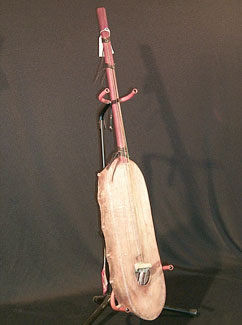
The Gimbri is a lute type instrument, generally bearing three strings. Here's what one very informative website says about the Gimbri:
Gimbri, guimbri or sintir. The gimbri or sintir is a three stringed rectangular lute from Morocco commonly used by Gnawan musicians. The body of the gimbri is a rectangular trough covered by camel skin from which protrudes a round wooden neck with three goat-gut strings attached by cloth thongs. At the end of the neck a metal rattle is inserted to give the instrument added color. The gimbri is both a percussive and melodic instrument producing a percussive bass-like tone, and is the largest in a family of similar instruments found in Northern Africa. The knuckles of the right hand hit the skin on the body, while striking the bottom string with the index finger, or plucking the top and middle strings with the thumb. Done properly, this technique will simultaneously produce the tone of the string, a drum sound on the skin, and rattle the jingles on the end of the neck. Advanced players produce complex combinations of rhythms and melodies by varying these three elements. at
http://www.asza.com/igimbri.shtml.
More on the instrument and the people who play it can be found at these wiki entries
and
As the sintir is used mainly by Gnawa (North Africans of Sub-Saharan African descent), it is likely that the instrument derives from similar skin-covered lutes of the region around Mali or other areas of the Sahel (such as the ngoni, xalam, or hoddu). and
The sintir (Arabic: سنتير), also known as the Guembri (Arabic: الكمبري), Gimbri or Hejhouj, is a three stringed skin-covered bass plucked lute used by the Gnawa people. It is approximately the size of a guitar, with a body a carved from a log and covered on the playing side with camel. The neck is a simple stick with one short and two long goat strings that produce a percussive sound similar to a pizzicato cello or double bass.
The Gnawan musicians are another story entirely, as they are known for playing trance music with the Gimbri and other instruments and the story of their tribe(s) is quite an interesting one. An old way of nomadic life, once very nomadic, just barely holding on the modern world. But living on with marvelous music and interesting traditions.
I first heard a Gimbri in 2001 or 2002, on the inaugural CD of Robert Plant's Strange Sensation project. The immensely talented Justin Adams, British by birth but largely raised in the Middle East, does a fantastic job of merging blues, rock and roll and various middle eastern genres and styles into what really gave Plant a cutting edge on that first Strange Sensation CD.
On the much covered "Hey Joe" version on that freshman effort , Justin Adams plays the hell out of that Gimbri, particularly in the haunting introduction and in a mid-song trance type solo. After hearing this song and seeing it live on a dvd bootleg someone sent me, I had to find a gimbri.
I found that even the new age-y drum circle drum stores had no idea what I was talking about. The internet educated me greatly about the instrument, the history of the Gnawan people and how much this instrument was involved in their lives. Of course, not even exotic instrument stores sold them, at least none that were listing on the internet. There were none ever on ebay or any other music sales forum.
Most people had no idea what they were and just said "hmmmm".
I hit listserves and various african music forums. I made postings expressing an interest in getting a gimbri. After a few months, an italian fellow contacted me who had made an impulse purchase traveling through the sub-sahara, and wished to sell it. It was well packed and arrived soon, and I paid a very cheap price for it.
Mine is a bit smaller than the larger gimbri's, and the body is more rounded than square. Mine is more like a Ngoni, but they are all very similar, just differing somewhat in depth of tone. Carved from a solid log, the neck appears to be some sort of large curtain rod replete with a decorative knob on the end. It has some sort of skin, with some hair still intact, on the head of the gimbri, and uses large wooden tuning pegs to tune the strings. The bridge is a rudimentary hand carved affair.
But it has a trance-like sound. Since the only licks I really know are those from the Hey Joe cover by Plant, Mrs. El Fisho is not often entertained by my musical trance attempts.
Likewise, at least yearly I gather with a group of friends who I have been playing music Since the 1980's. For years, we gather on weekend music making and fishing trips in cabins and on ranches and farms where we can get access. We've been playing various versions of Hey Joe for many years, and after the Strange Sensation arrangement arose, I of course developed the brilliant idea that I would surprise them with it at our next gathering.
The Gimbri was not well received. Although I had mounted a vintage Electro-Harmonix microphonic pickup on it, and therefore could blast it through an amplifier, it was not as appreciated as I thought it would be.
I continue to play it around the house, however, and it's a great wall hanger for the drum room. I occasionally use it on home recordings, as I enjoy it's sound. Although no one else seems to.